
Solar Water Pumps in Coimbatore: Freeing Farmers from Restricted Agricultural Power Supply Hours
by OMI Team
28 July 2026
For many farmers across the Coimbatore-Tiruppur region, irrigation still depends on when the grid decides to supply power, not on when the crop needs water, which is exactly why solar water pumps in Coimbatore are becoming the practical answer for farms that cannot wait for a fixed schedule. Restricted agricultural power supply hours have long shaped how and when farmers can run their pumps, and solar offers a way around that constraint entirely.
Why do grid-connected pumps still run on restricted hours in Coimbatore?
Farmers in this region have campaigned for sustained three-phase agricultural power supply for years, and whilst TANGEDCO’s feeder-segregation programme, covering more than 1,600 feeders, is a genuine step forward, it remains a work in progress. Until it is complete across every feeder, many farms continue to receive power in limited windows rather than on demand, leaving irrigation timing at the mercy of the supply schedule rather than the crop’s actual needs.
How does a solar water pump remove the dependence on the power schedule?
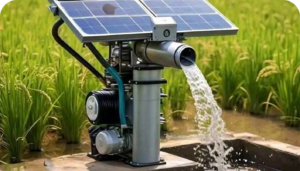
A solar pump draws directly from sunlight rather than the grid, so it runs whenever the sun is available, independent of feeder schedules or supply restrictions. For a farmer used to planning irrigation around a handful of permitted hours, this is a genuine shift: watering can follow the crop’s requirements and the day’s weather rather than a timetable set elsewhere.
Can a solar pump cope with Coimbatore's borewell conditions?
The region’s mix of borewell depths and seasonal yield variation means pump selection matters. Solar submersible and monoblock systems sized correctly for a given borewell can deliver the flow rates irrigation needs without drawing on grid power at all, whilst open-well systems suit farms drawing from shallower sources. Matching pump capacity to actual borewell yield remains just as important with solar as with any grid-connected setup.
What does a typical solar pump setup look like for farms in the region?
A standard installation pairs a solar panel array with a submersible or surface pump and a controller that manages output through the day. There is no dependence on batteries for most daytime irrigation use, since the pump simply runs whilst the sun is up, which keeps the system relatively straightforward to maintain compared with a grid connection tied to restricted hours.
Is switching to solar pumps a realistic option this season?
With feeder segregation still incomplete across the region, restricted power hours are likely to remain a reality for many farms for some time yet. Moving irrigation onto solar now, rather than waiting for grid improvements that are still in progress, gives farmers control over their own watering schedule immediately rather than at some uncertain future date.
Coimbatore’s farmers have spent years pressing for a more dependable power supply, and solar water pumps offer a way to stop waiting for that outcome. If restricted supply hours are limiting your irrigation, OMI Pumps, based right here in Coimbatore, can help you assess whether a solar pump setup is the right fit for your farm.
Talk to our solar team
Not sure which solar pump suits your land?
Share your water source, depth and acreage — we’ll recommend the right configuration.
Company Profile
Our Pride – Our Pumps
Let's help you!
Reach Us
Mail Us
Address
FROM THE BLOG
More Articles
Solar Water Pumps in Coimbatore: Freeing Farmers from Restricted Agricultural Power Supply Hours
For many farmers across the Coimbatore-Tiruppur region, irrigation still depends...
Solar Pumps: A Farmer’s Irrigation Readiness Checklist for the Rabi Season
September is decision time, not sowing time. It is the...
Solar Pumps: A Practical Guide to Choosing the Right Horsepower and Capacity for Your Farm
Choosing the right solar pumps for your farm is one...
Solar Water Pumps in Coimbatore: Essential Monsoon Maintenance Tips for Uninterrupted Irrigation
The monsoon season brings welcome rain to Coimbatore's farmlands, but...
